
James Sucks
In Percival Everett’s admirable novel Erasure, Thelonious “Monk” Ellison is a highly educated, articulate. upper-middle-class African-American novelist and classics professor. He writes intellectually dense books that garner much critical praise but no commercial success.
Monk blames mainstream reviewers’ and publishers’ addiction to debased fictive caricatures of “authentic Blackness,” ie vulgarity, poverty, crime, violence, prison, drugs, domestic chaos, and above all grievance, bellowed in subliterate ebonics— caricatures required by white liberals so they may play the White Knight as they ‘aid’ said oppressed.
Disgusted, Monk, in protest, writes an over-the-top parody of already parodic black fiction under the pen name ‘Stagg R. Leigh.’ The novel is called My Pafology (later changed to Fuck), the maniacal memoir of black criminal navigating the inner-city hell of a surreal negritude that has nothing to do with Monk’s (or Everett’s) upper-class academic lifestyle.
Monk sends it to a publisher. It becomes a massive hit. Is hailed as an authentic masterpiece. Is nominated for major literary awards. Monk watches as white critics and Black intellectuals alike celebrate a book intended as a sick joke and designed as a grotesque parody. Monk is appalled. He punches a man (a white man, of course) in a bookstore for saying that “Stagg R. Leigh speaks the truth.”
Monk is filled with disgust at both white and black critical communities. He rages. He seethes. But… the book sells. Monk’s financial problems vanish.
So, at no small cost to his integrity, Monk puts his actual identity away and takes the podium as Stagg R. Leigh. A sense of shame remains, he wants to confess his imposture, but the roar of the crowd is too overwhelming, and drowns him out.
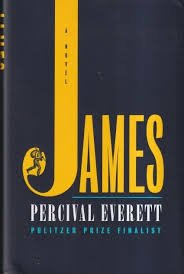
Life imitates art! In James, Everett serves up a tale of slavery that checks off every item on the miles-long scroll of black grievance, and panders to every cliché intoxicating to the masochisms of the progressive white mind. The result? A bad book–worse than bad, problematic; but needless to say, the glorification has been as fawning as it is universal.
The New York Times: “Huck Finn Is a Masterpiece. This Retelling Just Might Be, Too.” Elle: “…a masterpiece that not only becomes instant canon but also sets a brush fire to the current ones it stands upon…”. The Wall Street Journal: “[A] careful and thought-provoking auditing of Huckleberry Finn.… More than a correction, it’s a rescue mission…” Chicago Tribune: “Everett [is] our current Great American Novelist.… JAMES is a masterpiece that will help redefine one of the classics … I almost cannot imagine a future where teachers assign Huckleberry Finn without also assigning James alongside it.”
The accolades cascade on. Starred reviews from Kirkus, Booklist, and Publishers Weekly hail James as “ingenious,” “an absolutely essential read.” The book is slated for filming by Stephen Spielberg, is seated front and center in every Barnes & Noble in the country, and is now winner of the Pulitzer Prize, edging out a historical first trio of female finalist nominees. Edging the ladies out without James itself even being nominated! (Sorry, girls. Maybe next year.)
Such adulation! And yet, to paraphrase Galileo, it sucks.
What is it that makes James so very goddam bad?
Three things.
First, its very conception. James is not an original novel, but a ‘re-imagining,’ ‘Re-imaginings’ are what contemporary critics call fanfiction written not by young fans but by old deconstructionists eager to take down politically incorrect classics. Like the tearing down of Confederate statues, or the transformation of The Wicked Witch of the West into a bald chlorophyll Oprah, the goal is to take long-beloved but regrettably white or Western icons, and rebrand them as racist shit.
The trend is too coordinated to be entirely spontaneous. James was written and published in parallel with the fatuously titled graphic novel Big Jim and the White Boy, another ‘correction’ in which, Soviet-style, wise brave noble heroic moral titans (ie blacks) outwit and overshadow weak vicious evil dimwit psychotics (white boys) throughout. (A sniveling decrepit elderly Huck weeps ‘I’m a monster!‘ as Christ-like Big Jim hugs him and forgives him his trespasses.)
Where are the contarian re-imagings, one wonders? The white version of Native Son told from the perspective of those raped and murdered by Bigger Thomas, or the re-imagined To Kill A Mockingbird in which the rape accuser (‘Believe All Women’) is in fact a actual innocent victim, sacrificed to Atticus Finch’s need to wallow in white liberal sanctity?
This is to fantasize. There are no right-wing re-imaginings of left-wing sacred texts. The deconstruction is all one way, which is what makes the whole performance so cloying. It isn’t entertaining because it’s so predictable. It’s not fiction, it’s puppetry.
The Wind Done Gone is typical: a recent ‘re-imagining’ of Gone With The Wind by novelist Alice Randall, told from the perspective of a female slave on Scarlett O’Hara’s plantation, the supposed daughter of Scarlett’s father and (incredibly) the bulbous Mammy.
Alas, copyright law was still in effect on the beleaguered original (now issued with a warning label), and the Margaret Mitchell estate sued, alleging theft of characters, settings, plot elements, and so on.
The charge was as true of The Wind Done Gone as James. But on behalf of the three-judge panel allowing publication anyway, Judge Stanley F. Birch Jr. wrote, “Randall’s work flips GWTW‘s traditional race roles, portrays powerful whites as stupid or feckless, and generally sets out to demystify GWTW and strip the romanticism from Mitchell’s specific account of this period of our history.” Make whites “stupid and feckless,” denigrate the South, and legality can done go too.
Mark Twain has no such ‘protection,’ and so, stealing his work as well the unoriginal approach of Miss Randall, Mr. Everett has gone on to take characters and plot elements from Huckleberry Finn and invert them to serve Critical Race Theory with masterful abandon.
But not, alas, the same characters—the funny, human, conflicted, unpredictable, wily, dumb, realistic cast of Huck Finn. In the cartoon universe of James, sock puppets replace the originals. Every last (white) person is vicious, untrustworthy and deadly. Every black person is a righteous victim. The amiable, humane, decent Jim of Twain’s classic is now James, the cold-eyed recorder of white depravity, Jean Valjean in blackface, mad as hell and not willing to take it anymore.
One can sympathize. It must be difficult to be a celebrated novelist and a thoughtful, tenured academic and black, and entirely savor a book in which the word nigger appears over 200 times.
The problem is that Everett’s riposte, James, is not a critique of racism, but a celebration of it: a fantasy realm where omnipresent white vileness chafes outraged black hyperlucidity every single moment till white blood flows red. Racial debasement is not the target in James; it’s the modus operandi.
Such is the power of literary ingenuity that even racist literature may still make for powerful reading. Louis-Ferdinand Céline is racist as hell, but Mort à Crédit remains as much art as rant.
The problem with Everett’s white-bashing variations on Huck Finn, however, is that, as Hemingway put it, “All modern American literature stems from one book by Mark Twain called Huckleberry Finn.” Hence any such ‘re-imagination’ had better be pretty damn good not to suffer from painful inferiority by comparison.
Suffer by comparison James does. On multiple levels. For one thing, Finn was a stylistic bombshell. In a Victorian literary world dominated by garrulous Dickensianism and cascades of neo-Shakespearean logorrhea from Carlyle and Melville, Twain lobbed the grenade of American vernacular, a demolition from which English has yet to recover.
The prose of James is more than adequate—taut, sound, AP-suitable MFA workshopbabble sprinkled with the occasional bitter bon mot. Everett is a fine writer, and the commentary issuing from his James is as taut and snide as any Bennington Review feuilleton. But not remotely earth-shaking.
Moreover Twain was an abolitionist, and no stranger even then to its proto-Woke tropes. He too gleefully savaged whites, mocking in Huck Finn moronic white con men like the Duke and the King, disdaining feuding white morons like the Grangerfords and the Shepherdsons, all while continually playing up the fundamental kind-heartedness and decency of the black runaway slave Jim.
But back then the racial division of humanity into POC Good and Cis Pale Evil was not yet absolute. The Dukes and Kings might be moral and intellectual cretins, but Huck, though white, was decent and likable. Even authority figures like Judge Thatcher seemed upright and well-intentioned.
And while Jim was far richer in virtue than the other characters in Huck Finn, he was not invariably wise, right, articulate or without flaw. Jim could be superstitious, credulous, take offense, laugh, cry, fall for a prank. Which is to say, he passed not for white but for human, which is made the book believable.
No prank gets by the title character in James. He sees through every white character from the start. Why not? Every last white in James is either a dimwit or a sadist, invariable sociopaths in whom all empathy, decency and manners dissolve at a mere glance at black skin. If a white person befriends James, it’s either a quickly discarded act, or the ally turns out to be only passing for white but really black, like Norman, or Huck himself.
Even God can’t dupe James. For all Everett’s proclamations of the primacy of language and the worth of books when it comes to shaping identity, James’ reverence for language stops dead at the King James. Copies of Rousseau he steals, the Authorized Version he leaves behind. Far from white eyes, James lectures a sextet of young slave children:
“Why did God set it up like this?” Rachel asked. “With them as masters and us as slaves?”
“There is no God, child. There’s religion but there’s no God of theirs… Religion is just a controlling tool they employ and adhere to when convenient.”
Every history of American slavery records the passionate African embrace of Christianity; antebellum slave atheism merits not a single monograph. But Everett is an atheist, and so for the James he fashions, however supposedly in love with language, ideology comes first, historical accuracy second, verbal sublimity last.
By itself, animosity against Christianity wouldn’t necessarily make for a bad book, much less animosity against whites during slavery. A black slave in 1861 would have excellent reason to fear, avoid, and hate many if not most of the whites he or she encountered, as well as good reason to observe them closely and without much kindness. An exploration of the way things looked to such a slave, especially a hyperintelligent, hyperarticulate slave, even as it traced that slave’s eventual embrace of racial murder, could easily be a book worth reading. Indeed, Styron’s Nat Turner was such a book.
James might have been such a book too. Cut the link to Huck Finn, change James’ name to Joe, and Huck’s to Jack, and shift sailing on a raft to running through woods and fields, and the story line of the novel need barely change at all. If anything it would improve. Is James really enhanced by the insertion of the loutish cretins Duke and King? The duo are there partly to spare Everett the labor of inventing new characters by varying from Twain’s template, and partly to present whites and louts and cretins. When Everett does vary from the template, the results genuinely shine: the invented minstrel episode is far more in line with Everett’s preferred nods to multi-layered postmodernism than Twain’s original.
Ah, but then it would not be a dig at Twain. And this is one of the pitiful things about James. It could have been a good book, or at least an honest, thoughtful book. Everett could have written a straight original novel about a genuinely articulate literate slave and his half-black son escaping the South on the eve of the Civil War. It could have traced his psychological development from victim to murderer in ways tragic and illuminating and moving.
But then he wouldn’t be trashing Huck Finn. And the need to gouge that humane predecessor drives Everett time and again into truly wretched novelistic choices: simply awful, clumsy, story developments. Supremely, the Darth Vader “I am your father, Luke,” moment in which Everett reveals Huck to be James’ son. This ‘revelation’ is hinted at so soon, so often, and so ham-handedly that when the implausible ‘surprise’ lands, it’s with relief that the interminable wait is over.
But the problem isn’t just that Everett signals it from a mile away. James is one generation away from Africa. Is it really plausible that that his son Huck passes imperceptibly for white in the race-hypersensitive slave South of the book, or that an application of white powder over black powder to James’ face allows him to pass as white in a minstrel show?
The entire story line revolves around Jim possibly being sold, and escaping so he can make enough money to come back and buy his family’s freedom. By the end of James, he does return to his family, penniless, and simply takes them along and escapes with them, killing the obstruction of a honkie along the way.
Why not just escape with them in the first place? Because they’re safer left at home with Miss Watson and Judge Thatcher? But they’re not. In Huck Finn, we’re given no good reason at all for Miss Watson to consider selling James. (In James, James steals from her. But, ever the dimwit Caucasian, there’s no indication that she knows it.)
If James is sold on whim, why should James imagine his wife and child won’t be sold on a similar whim—indeed, that it’s not more likely that they’ll be sold if James runs, and that inclines them to join him? The whole plot loop starts for no good reason, and ends with less.
The book fails even as exposé. For if the idea of the book is to retell Huck Finn from Jim’s angle, it doesn’t: it tells a story in which the original incidents are edited out and new ones included; a story systematically set up to justify James in his concluding racial killing spree.
In Huck Finn, Twain presents far more stupid, destructive and detestable whites than blacks. But he’s trying to write truthfully, not ideologically, so he does present a few decent whites. The Phelps family are among the kindest, and may be the best sketches Twain ever made of genuinely admirable folk. Everett, needless to say, deletes them entirely.
In Huck Finn, Judge Thatcher too is presented as a decent soul, trying his best to protect Huck from his abusive father. There’s no suggestion that he owns slaves, arranges the sale of slaves, or has anything to do with slaves. There’s no hint that he has anything to do with James’ family, or that he interacts much with James at all. Why should he? James belongs to Miss Watson, he isn’t Thatcher’s slave.
But Everett needs to unload on some straight old white man, so, in Everett’s reconstruction, Judge Thatcher arranges the sale. More than that. In James, unlike Huck Finn, Thatcher is presented as personally whipping and permanently scarring James for saying “Hello” to a white woman who says “Hello” to him first. (What’s James supposed to say to the woman? “Screw you?”)
James apparently learns to not only read but deploy a prose style worthy of Don DeLillo by stealing books from Thatcher’s private library and grasping what the marks on the paper refer to through sheer osmosis. But since James isn’t Thatcher’s slave, shouldn’t Thatcher be a bit curious about Miss Watsons’ slave being in his house and private library enough to earn a MFA, particularly when his books vanish afterwards only to reappear after James does? I thought slaves were busy being whipped all day while picking cotton. Where does James get the time to sit in Judge Thatcher’s home all day savoring Locke and Voltaire till intellectually satiated?
The question is not moot, for one of the tales in the book involve a slave who steals a pencil with which James can write. We later learn that the slave is then tortured and murdered, all for the suspicion of having taken a pencil.
Antebellum Southern laws against murdering slaves aside, the price of a slave back then was roughly equivalent today to something between the price of a new BMW and that of a small house. You’d imagine the slave owner would simply sell a thieving slave, and accrue the equivalent of five to six figures. Or better yet, just buy a new pencil.
Nope: in the world of James, Evil’s gotta evil, and maniacal psychopathic retribution is Whitey’s only recourse
But only Whitey’s—at first. When James returns, and learns that Judge Thatcher has sold off his entire family (a family which Thatcher doesn’t own in the first place), he ties Thatcher up at gunpoint, and accuses him of raping black slave women and whipping enslaved black men. (Thatcher’s silence, at gunpoint, “was profound.” Guilty!)
James describes to Thatcher his recent murder of a white rapist: “I strangled him. Watched his feet twitch as he died, just like he was dangling from a rope. It was quite ugly. I actually felt a little bad for him. I guess that’s the difference between you and me.” (True enough: Thatcher is merely a judge, while James is judge, jury and executioner.)
Yet though James is capable of slowly strangling a man to death a man for raping a comparative stranger, he doesn’t kill or even so much as slap Judge Thatcher, who has scarred his back and just sold James’ own wife and daughter to what in the book amounts to a rape camp.
Unfortunately for Thatcher, James exacts an even more terrible vengeance. James subjects Thatcher to, quote, “the most terrible thing a white man can experience”—namely, a black man using English fluently.
It’s all so… stupid.
One can excuse Everett for some of the plot gaffes. He was working, alas, from Twain’s picaresque original, where clunky developments and moronic incidents were not rare. He would not have had to, if he’d only written a completely original work. But the cruel James is tied to Twain’s original, everywhere superimposed over the high spirits, humor, and humanity of Huck Finn. The constant comparison irreparably drains and cheapens the former.
In particular, it cheapens the hero—Jim. One thinks of the climax in Twain’s original, in which Jim is willing to be captured rather than let a injured boy, Tom Sawyer, die. A black man sacrificing himself for a white boy? Everett deletes it. Or the moving passage in Huck Finn where Jim tells his daughter, recently recovered from Scarlet Fever, to shut the door and she apparently refuses. Jim slaps her. Then he slowly realizes that the fever has left her deaf and dumb. He falls to his knees, embraces her, bursts into tears; he’s devastated, ashamed, heartbroken. The reader can’t but feel for Jim.
That story too is stricken from James. After all, where’s the white villain?
All of James is like that. Everett repeatedly tells us that his James loves his children, loves his family, and wants to go back and rescue them, but there’s barely a shred of characterization or description or shared memories. James’ children are simply a device to keep the plot moving, to eventually justify James shooting the whites he loathes. Whereas to Twain’s Jim, his daughter is palpably, painfully, a real individual. Time and again, James rings false because Jim rings true.
But great as the weakness by comparison with Huck Finn, the accumulating plot implausibilities, the replacement of character with caricature, it’s in the second great flaw of James, the realm of style, language, that the book most vividly falls down.
Stylistically, Twain’s spectacular and groundbreaking pirouettes in American vernacular are not to be outdone. His groundbreaking treatment of dialect literally altered the course of American prose. Wisely, Everett doesn’t even try. But what he does instead is to inserts twenty-first century university syntax and diction into the mouth not just James, but every mid-nineteenth century Southern slave he depicts. The incongruence is so jarring that he loses the reader on every page from the very first.
How exactly does a slave in the Deep South in the 1850s end up sounding like Malcolm Gladwell? Frederick Douglass became literate after years of being taught to read by his master’s wife, and Douglass’ galumphing Southern-inflected Victorian oratory followed reasonably enough. But for Everett, it’s enough for James to steal books from the library of Judge Thatcher and literally never hold a pencil till adulthood to be as terse as Hemingway.
James the narrator reads like a secular leftist Northern professor plopped down into the Deep South as part of a Civil War reenactment, keeping private notes on the gauche mendacity of the redneck Trump supporters surrounding him. And that novel might have been fun. Even insightful. But as a clone of Huck Finn’s James, even a ‘re-imagined’ one, it simply isn’t believable. Every time James opens his mouth you hear the MFA cadences of translated Foucault.
The book lurches even further into the bizarre as James presents every slave speaking in the same crisp Northern diction, consciously and universally concealing their lucid syntax under a black patois only when speaking to whites.
At times the slaves’ dialogues leave even the suspicion of satire behind, as when James and another slave discuss a white buffoon passing by:
“He’s going to get drunk now, not so much because he can, but because we can’t,” I said.
Luke chuckled. “So, when we see him staggering around later acting the fool, will that be an example of proleptic irony or dramatic irony?”
“Could be both.”
“Now that would be ironic.”
I ask you: is this really a plausible example of casual private conversation among Southern slaves in 1861? The absurdity grows titanic as James discourses not merely in lucid sentences but in hallucinatory dream dialogues with Voltaire and Locke and further Enlightenment worthies. Exchanges from which James, of course, continually emerges as superior. Opines James in his sleep:
“You have a notion, like Raynal, of natural liberties, and we all have them by virtue of our being human. But when those liberties are put under societal and cultural pressure, they become civil liberties, and those are contingent on hierarchy and situation. Am I close?”
Voltaire was scribbling on paper. “That was good, that was good. Say all of that again.”
Ah, yes. Where would Voltaire be if he hadn’t leapt to take notes as snoozing James waxed eloquent on cultural contingency.
This tic of inflating black intellectual credibility by citing white Enlightenment authors is fatuous enough; it becomes embarrassing when Huck asks what wishes James would ask of a magic genie, and James muses to himself:
“The question I played with, but certainly couldn’t share with Huck, was what would Kierkegaard wish for.”
I’m not surprised he couldn’t share it. The year is 1861, and Kierkegaard wasn’t translated into English until 1877.
A genuine scholar would have caught the slip, and competent editing from Everett’s publishers would have too, not to mention competent reviewing from fawning Times and Kirkus and Elle reviewers.
But hey—maybe when not engaging in slave labor, being whipped, lecturing on white theology, performing in blackface over whiteface, holding judges at gunpoint and fleeing lynch mobs, James picked up Danish on the fly, too.
But needless to say, competent editing, like historical plausibility, isn’t the point; the point is the posturing. The passage is there to present James as an erudite intellectual sophisticate, much like yourself, Dear Reader. It’s to nudge cretinous (white) readers to reflect with astonishment, “Wow, black people really can think and speak and clearly. Among themselves they talk just like whites!”
Yet isn’t that an almost ridiculously racist slap in the face of African Americans? Everett is telling us that when black Americans talk like black Americans—for a representative sampling, please catch a bus or visit any Popeyes—they’re deliberately trying to sound as stupid as possible, so as to allay white fears of possible black intelligence. Scots can develop their own dialect; the Irish can have their own dialect; but black Americans have no slang all their own. Only sly conspiratorial verbal strategies with which to dupe Whitey.
To read Everett is to be shown that, privately, among themselves, American blacks engage in a white discourse that is not only a model of clarity, but occasionally brims with a linguistic elegance worthy of Scott Fitzgerald if not Evelyn Waugh. Between themselves, Jasmine Crockett and Kanye West chat like Sir Kenneth Clark addressing King Charles.
But not in public. Lest they taste the lash.
The rickety holes in plot and characterization, and the grueling clashes with Twain’s original are painful enough. This particular linguistic tic of Everett’s loses the reader almost every time James writes a line. But even worse is the growing suspicion that it’s not so much a literary conceit as a crank obsession.
Time and again (and again) Everett states flatly that whites are terrified of the notion of a black person speaking in articulate non-ebonic English. Even as James describes his slow strangulation of a white man to the white man he has just tied up and may well murder too, he assures us that what really terrifies that white man is not imminent death but the shocking possibility that a black man could use the pluperfect subjunctive properly.
I honestly do not see where Everett gets this crackpot notion, unless it’s an academician’s justification for his more sophisticated literary productions not selling. Well, Whitey wants you to sound dumb! Except that wasn’t even true in 1861, when Frederick Douglass’ command of language had already made him one of the most popular speakers in the country; or before, in 1861, when Phyllis Wheatley’s poetry won the admiration of George Washington; and especially not in our day, when black writers from Ellison to Baldwin, Chester Himes to Ishmael Reed, Charles Johnson to Everett himself, receive award after award.
But the literary problem is not a matter of some crank racist belief about a supposed white fear of clear articulation. The literary problem is historical verisimilitude: that, as a novelist, Everett chooses to deploy language which consistently trips up the reader with its implausibility, so that instead of being drawn into the story, the reader is repeatedly pulled up short. As with Brecht’s Verfremdungseffekt, his alienation effect, the reader is constantly distanced from the tale, constantly made aware of it not as story but propaganda.
And shallow propaganda at that. For just as the plot and characters of James are unoriginal, so its ideology. The message of James is that of Critical Race Theory: that whites without exception are intrinsically uniformly evil, and that blacks (barring a sprinkling of race traitors) are good; so good that they’re justified in killing the pale, evil Other.
That’s not the message of Huck Finn. Twain could mock doltish white con artists like the Duke and the King, and wince at white lunatics like the Grangersons and the Sheperdsons. But the fundamental decency of Huck and even Tom shine through Huck Finn, as does the moral worth of Jim. For in Twain, good and evil, wisdom and foolishness, exist within all people.
Not so in James. Here, every last white person is either a dimwit or a sadist. The whites in James range from cold to vicious to outright mentally ill. When a white person acts to befriend James, he turns out to either be passing for white, like Norman, or unaware of being black, like Huck. There are no exceptions. The black characters, by contrast, even the occasional race traitor cooperating with whites, are overwhelmingly alert, observant, sympathetic, virtuous, exchanging private hyperarticulate commentary under the mask of ebonics. The world of James is black and white, not only racially but ethically and morally.
And that’s the tragedy. James dehumanizes the dehumanizers so thoroughly that he joins their ranks, strangling a white man here and blowing a white man’s brains out there not just with absolute justification but with soul-satisfying brio.
This deformation of Twain’s larger, and finer, moral arc is the third and truly fatal flaw of James. Huck Finn proceeds to Huck’s full realization of Jim’s humanity, and his commitment to helping him escape slavery even if it means he goes to Hell. James is the record of James’s passage to Hell: a passage from subjection to, aversion for, and lifelong deception of whites, to murdering them outright.
It’s said that in most bad books a better book strains to get out. Here it all but pounds at the door. Mr. Everett could have skipped trashing Huckleberry Finn and wallowing in revenge porn, and written the book I think is much closer to his heart, a deeper Erasure in which the intellectual struggles against the frustrations both of a limiting minority subculture and a patronizing majority one, a book in which the antimony is not black versus white, but the conflict of the highly intelligent man forced to navigate a much coarser and less intelligent mass society. The world of Monsieur Teste, the Underground Man, Ovid among the barbarians.
Sadly, uncontrollable disdain for white people distances Mr. Everett from this larger theme; but there is a genuinely good novel waiting there and I think it is Mr. Everett’s true conflict and subject. I hope that, after making a bundle catering to the white masochism of the ruling literati, he eventually manages to write it.
In the interim, however, he’s authored James, a sad absurdity of a book, hitting every trendy anti-white cliché with a truncheon. It’s a shame, and a sham, and the worst of it is that Everett is in fact a fine writer of great talent. Like his protagonist in Erasure, however, he’s opted to serve up the degrading and dehumanizing cliches of a degraded Zeitgeist. Well, it’s certainly paid off. What other standard is there?
What makes this sorry book a fit subject for a science fiction review? Its flavor. I don’t normally review historical fiction, but at no point in reading James did I believe I was reading historical fiction. I everywhere felt I was reading the faux science fiction permeating pop literature nowadays. You know the type. Ishiguro’s Klara and Never Let Me Go. Iain Pears’ Arcadia. It looks like science fiction, but it’s not, and it looks like regular fiction too, but it’s not that either.
Percival Everett could have rescued James, I think, by fessing up to its essentially science fiction premises. He could have written it as a kind of time travel novel in which Cornel West is set down on a raft in Mississippi circa 1861 and gains Agency and affirms Identity by gibbering reams of academese before going on to spill white blood. Or, to be precise, white Southern blood, in the spilling of which white Northern book buyers yet take joy.
The virtue of this imaginal version of James, in which a highly intelligent, highly articulate black professor of English—someone much like Percival Everett—steps into a Silicon Valley time machine and finds himself in 1861, would at one stroke have solved nearly all the problems that crush James as it is, from linguistic and historical implausibility, to freeing the author from any need for bungling redeployment of Twainian tropes. Pop the BLM Antifa of today into yesterday, and it would all have made sense, and even given the narrator free rein to comment in ways and with a scope impossible even for the implausible central character of James. It might even have been funny, not dreary. That’s how close it came to being a real novel, and not agitprop.
But then that would have been science fiction, too lowly a genre for the Pulitzer Prize Committee and the fatuous snobs of Elle and Paris Review. The more false and rigid the ideology, the more rigidly it must pose as truth. And so we affix the mask of historical unmasking onto Everett’s otherwise blithe sci-fi comedy, and pretend that Everett is showing us the shocking reality behind whitesplainin’ Mark Twain and Huck Finn.
What are we left with instead? James, a linguistically ridiculous, historically inaccurate, fanfiction apologia for race murder.
I’d like to regard James as a blip. Unfortunately, Mr. Everett has indulged a taste for racist vengeance porn before. In The Trees, relatives of the late Emmett Till decide to visit rough justice on relatives of the lady who once accused Till of attempted rape. An interesting take on #MeToo: we should #BelieveAllWomen… unless they accuse a black man, in which case justice involves not just blaming the woman but murdering the lady’s relatives. In The Trees, this murderous pattern goes viral, and bodies of castrated white men find themselves littering hill and dale in ever-increasing numbers. Nice.
I want to believe that Everett wrote James not so much out of naked avarice or racial paranoia as editorial coercion. It’s clearly part of a publishing and marketing trend, the sort of book that is so up the Woke alley of BLM-fellating mainstream media and reviewers that it’s already made Mr. Everett a small fortune. A fortune is hard to resist, but then genuine intelligence and talent that is not small is a shameful thing to waste. In James, that talent and intelligence is worse than wasted, deployed to take down a much finer book in the interests of fostering murderous racism posing as anti-racism. It’s worse than a bad book: it’s a moral failing.
Percival Everett is a thoughtful, articulate, gifted writer with a body of work behind him that, largely, is as interesting as it is substantive. Erasure, Dr. No, Glyph, are well worth any reader’s time and attention.
James is the inversion of that promise. Now that it’s made its author rich, perhaps he will use the opportunity to devote the time to write the good books of which he is certainly capable. I hope so.
Alas, the trajectory does not look good.