
Shitty On The Edge Of Forever
Harlan Ellison was, by most accounts, one of the most obnoxious individuals ever to work in science fiction. The author of “I Have No Mouth And I Must Scream” had an astonishingly big mouth which he used throughout his career to scream at others at the top of his lungs.
That he had flashes of genius as well I do not dispute. But Ellison also had either the insensitivity or self-insight to channel his abrasiveness into the moronic collective that is television production, is which the Romantic Artist is ritually castrated by dimwit producers, cost-crunching financiers, egomaniacal actors, gutless censors, and all the other hacks determined to shave away all trace of originality in a screenplay in the name of producing a popular product to a market they despise. Confrontation followed. Reaching an ear-splitting intensity that bordered on the Carlylean.
Ellison was nonetheless able to take the bulk of the credit for some of the best SF episodes ever done. Science fiction is honored to include in its corpus episodes like City of the Edge of Forever, Demon with a Glass Hand, and Soldier. Yet Ellison bitched and moaned about each, complaining all his life that his pristine vision had been besmirched by the oafs surrounding him his entire career.
Well, Harlan is dead now, a development garnering as much applause as regret, and some of his unbesmirched originals are now posthumously gracing the public. Were they in fact the suppressed works of genius he claimed?
Let’s have a look at perhaps his finest (televised) moment: City on the Edge of Forever. Pretty much conceded to be the finest episode of Star Trek: The Original Series (if not of Star Trek overall), we have all seen it many times. Kirk and Spock go back to the Depression Thirties, where Kirk falls in love with an idealistic social worker, Edith Keeler. Uh oh: it turns out that her later pacifist activism keeps the United States out of World War Two, leading Hitler to develop the A-Bomb first, leading to Mirror Universe ickiness instead of the Federation.
To stop this from happening, Edith Keeler Must Die. In the revised, televised version, incredibly, Kirk does not find a way to save her, but lets it happen; even more incredibly, he underacts, his agony sober and tight-lipped as he does what must be done.
It’s a powerful, moving, classic episode, and Harlan Ellison lost no opportunity calling it crap. Those damned producers, he moaned, destroyed the beauty that was his original screenplay and the exquisite trim and curliques that would have lent the episode immortal grace. Roddenberry in particular he slammed, even though it was the more than able D. C. Fontana who did the rewrite on Ellison’s original script (without ever getting any credit).
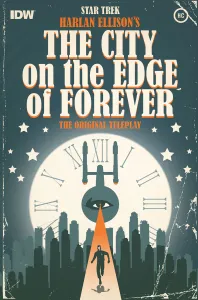
Well, we have the original screenplay now, and we even have a visualized version in comic book—oops, ‘graphic novel’ form. Guess what? The damned producers were spot on. Ellison’s acrid and corrosive additions would have added nothing but absurdity and debasement.
To be specific:
In the revised version, Kirk and Spock have to go through the Guardian of Time because good Doctor McCoy, trying to save an injured member of the crew, accidently injects himself with an overdose of medication. It drives him insane and he hops through the Guardian, somehow changing the past. Kirk and Spock follow to correct this, but also to rescue a dear and respected friend.
In Ellison’s version, a crewman on the Enterprise called Beckwith is a drug pusher and a murderer supplying a bridge officer with said drugs, who jumps into the past upon exposure to escape punishment. Is this really plausible? I say nothing of its indifference to Gene Roddenberry’s admirable and clearly stated vision, that in the future present-day curses such as poverty, racism, drug addiction, thuggery, etc, would simply be a thing of the past, a superceded relic of mankind’s babarian infancy.
I only ask whether its likely that Starfleet, with its presumably stringent training, high standards, and idealistic esprit de corps would let a individual that corrupt, or officers that weak, get through its vetting. Even if it did, would regular ship’s medical examinations miss the addiction? This is the Enterprise, not Club 54.
In Ellison’s screenplay, the fastidious Mr. Spock notes that Lebeque, the addict, has been stumbling around on the bridge “like a man underwater for over two hours,” nearly blowing up “the entire drive.” No “Report to Sick Bay at once, Mr. Beckwith”? Nope. We even learn that Beckwith not only takes drugs but deals them to the alien populations the Enterprise visits, and plans to retire a wealthy man on the proceeds. And Ship’s Security misses all this?
Consider it even from the dramatic point of view. DeForest Kelley gave what is arguably the best performance of his career as McCoy. It heightened audience concern for a character they liked and respected, and deepened his character as his torturous suffering from an accidental injection exposed his ambiguous feelings about his medical work. Would we really find the presentation of a Starfleet officer dealing drugs and bludgeoning others to conceal it more entertaining? Ellison would. Art’s about gritty realism, baby. Right?
Wrong, Harlan. Presenting Starfleet crewmen as shit serves no purpose other than making Star Trek a litte shittier. An understandable goal, given your generally nasty aesthetic. Idealism doesn’t sit too well with the craving to look edgy.
Beckwith acts as expected. Threatened with exposure, he loses it, kills Lebeque, and tries to escape by transporting down to the nearest planet. An Away Team led by Kirk beams down in pursuit. As they trek across what looks like a desert, Kirk muses, “A planet with a dying sun… it should be fried, without atmosphere… but we aren’t cold… and we can breathe…” Nice to that find out, after you’ve beamed down in the middle of it!
Remember the iconic look of the Guardian of Forever? That great timeless anthracitic ring, a Stonehenge-like door into Eternity? That wasn’t how Harlan saw it. His Guardian was a chorale of Guardians, a row of long-bearded Gandalfs who apparently just sat there for untold billions of years waiting to greet tourists. What exactly did they occupy themselves with all that time? Parcheesi? Apparently they just hang around and ‘guard Time,’ though not terribly well, since a strung-out lout like Beckwith can rush in, kick Kirk and company out of the way, and leap into the past (Depression-era California’s, for reasons mostly having to do with cheaper background sets).
The vastly old Guardians control the atmospheric conditions of an entire planet, and claim to know and, potentially at least, control all of Time. But they can’t keep Beckwith from gatecrashing into God knows when. Ooops! This causes Time itself to undergo such “trauma” that all galactic history is altered.
Ellison’s dialogue between Kirk and the Guardians is as laughably ill-written as it is pretentious. Kirk: “I always thought stories about time machines were the drunk-stuff of lab technicians when they had too much pure grain to drink.” (The ‘drunk-stuff’ of lab technicians? ‘Pure grain’?) A Guardian replies: “That which is…Is.”
It’s not implausible that a civilization might die out over the milennia. It’s not implausible that its artifacts might survive it for aeons. The pyramids have. It is implausble that its representatives would stick around for billions of years, only to do nothing but issue warnings in English to passersby who can, apparently with ease, give Time itself a total makeover.
Ah, but Harlan isn’t trying to reason things out. He just wants to insert a chorus of greybeard rabbis mouthing inanities and waggling their fingers at passing yokels because, you know, Starfleet military personnel are transient yokels, when they’re not junkies.
Somehow, the drug dealing Starfleet hoodlum hops into the past. As for the Away Team, they don’t care. They just beam back up to the Enterprise. Surprise! The Enterprise is now named ‘The Condor’ and is manned by a pack of thugs resembling Hell’s Angels having a badass beer blast. Kirk, Spock and Yeoman Rand beat their inebriated butts with a dash of Trek Fu, but clearly this new timeline has fallen below Federation standards, so the good guys must now return to the Guardians to set Time right.
Off go Kirk and Spock into the Thirties in chase of Beckwith. Will we now be entertained by the duo (which we were, in the revised teleplay) as they comically try to pass themselves off as regular guys in the Thirties?
Nope: Harlan doesn’t want us to smile: he wants to preach. Instead of focusing on the interesting and heroic characters we care about as they try to save their near-utopian future universe, Ellison shows us a mob listening to some speaker rant about immigrants taking their jobs. (What jobs? It’s the Depression, stupid.)
As the Trumpy rabble-rouser whips up the ragged hoi polloi, who should materialize out of thin air but Kirk and Spock. This would impress most people, but the grungy rednecks merely take the Vulcan, ears and all, to be a foeigner, and proceed to try and stomp them both. Spock phasers a lamppost out of existence, and the crowd abates as Star Fleet’s finest flee.
In the revised version, they hide in a basement and Edith Keeler comes down and lets them stay in return for help with her Mission. In Ellison’s original version, time is wasted as Spock, uncharacteristically, lambasts the humans who chased them, while Kirk is amused at Spock’s irressible human irritation. So much for character consistency.
Ellison does not want to appear insensitive to the poor, however. He concocts an impoverished beggar called Trooper, a double amputee who (we are told) fought at Verdun. Kirk gives him a few dollars. Did he fight at Verdun, or is he just playing on people’s pity to get more alms? I guess he did, because when Beckwith later tries to shoot Kirk, this legless amputee somehow jumps up (!) and pushes Kirk out of the way, taking the fatal blast in his stead. Talk about fighting spirit!
Why the hell should Trooper give his life for Kirk, and how does he even know what a phaser is, never having seen one? In Ellison’s original screeplay, motivation and plausibility doesn’t matter. Not content with a drug-dealing Starfleet bridge officer, Ellison wants to drag in an additional lowlife this time around so we can empathize with tramps in the gutter, not heroes from the stars. Tramps in the gutters are heroes too! Mind you, this has nothing really to do with the storyline, and you could spit it out in its entirety, as D. C. Fontana wisely did.
After wasting more screen time on this unnecessary narrative interpolation, Harlan gets back to Kirk falling hard for Edith, Joan Collins was not yet cast, so we have no assurance that she is hot, but she does mouth liberal platitudes non-stop. What more is needed to make starship captains from centuries hard? Spock tries to warn Kirk. Edith Keeler Must Die if the Federation timeline is to be restored.
But Kirk just can’t let her die. He does, in the revised version, which is why it’s so surprising and gut-wrenching. No such supreme devotion to duty in Ellison’s original: a truck comes out of nowhere to flatten her, and Kirk throws the Federation and Earth’s entire future to the dogs to run out to save her. Good news for all of space and time: Spock stoically but forcefully restrains the idiot. So much for one of the most emotionally intense high points of the entire Star Trek canon.
Time is set right, so the Guardians spew Kirk, Spock and Beckwith back to the corrected present moment. Oops again: Beckwith jumps back in anyway, giving those bozo Guardians the slip yet once more. But it’s OK, because this time he’s hopped into the heart of a burning supernova, and somehow or other it’s set to time-loop, so he’ll burn in a super-inferno for all eternity. I guess this is Ellison’s way of saying, don’t sell drugs, kids.
Justice is done, except that Kirk is still a little miffed at Spock letting the girl of his dreams get hit by a truck. The pair have a mano a mano discussion, which concludes, absurdly, with Ellison making Spock say, “No woman was ever loved as much, Jim, because no woman was ever offered the entire universe for love.”
The End. Thank God.
I have been slapping Harlan Ellison upside the head pretty harshly through this review, and I don’t want to leave the impression that he was as bad as all that. Far from it: Ellison was a master of the science fiction short story, and was responsible for some of the best science fiction television episodes ever, including City on the Edge of Forever. The fundamentals of the classic that eventually aired were all there, and I bring attention to some of the prelimary excreta that was mercifully deleted only to make the following writerly point:
Ellison was correct to throw so many elements, good, bad and absurd, into the original draft. It is the job of a creative artist to be creative, and Ellison did indeed generate all sorts of novel and unexpected notions and throw them together in unique ways.
But what he failed to do is separate the wheat from the chaff. It’s perfectly fine to go over the top when drafting a story. But to finish it properly, you have to weed out the weak parts from the strong. Ellison’s decades of rage over the film’s producers decision to apply was as inappropriate and infantile as his contibutions to the story were great. But the lesson is that re-creation—revision—is no less necessary than creation to the process.
This D. C. Fontana provided, and Ellison and Star Trek fandom owe her thanks. Fontana realized that, in a time-limited format like a television episode, less is more. The core of the story didn’t need amputees from Verdun, anti-immigration rabble rousers, drug-dealing Starfleet personnel, biker gang tag-team brawling on The Condor, pretentious yet impotent Guardians, eternal torture in the heart on the sun. The storyline was simple and hard: Kirk falls in love with someone who has to die for Starfleet to live. He has to make a decision: his civilization or the woman he loves. He makes that choice, and it is the right choice.
Why it is so shocking and powerful to most viewers? Because we live in a society that values personal gratification above all else. For moderns, there is nothing higher than Ego, than sentiment, and Kirk chooses not himself, not ‘love,’ but the social order: the high civilization that is the Federation and Starfleet.
In the weaker original version, Ellison takes that that choice away from Kirk, and the Kirk that results is painfully weaker. D. C. Fontana’s sober and unsentimental revision is like a splash of cold water. It is a very Roman lesson and a very stark choice: civilization or self. Everything nowadays exalts self. Which is why what passes for civilization is falling apart.
By their plot elements ye shall know them. The problem with Ellison’s original script is that Ellison was never in love with civilization, only with how best to corrode it. From enfant terrible to senex terrible, he was obsessed only with antagonism, with looking edgy, and the ethics of the edgy is an anti-ethics: it involve always tearing down what a culture considers noble, never building it up.
In the original script, Ellison takes Roddenberry’s vision of a future humanity that’s put its adolescence behind and risen to a higher level, and infects it with ‘innovative new’ insertions of drug-dealers, street amputees, poverty, protesters, and sentimental attachment over responsibility and duty. One can only thank the series’ producers for spitting them out.